



What Is a VIN Number? Meaning, Structure, and Where to Find It
A VIN, short for Vehicle Identification Number, is the unique 17-character code that identifies one specific vehicle. Think of it as a car’s fingerprint or social security number: no two cars on the road share the same one. It’s stamped on the car and recorded on its paperwork, and it’s the key that unlocks everything from factory specs to safety recalls to resale value.
What a VIN is and why it exists
Every car, truck, motorcycle, and trailer built for sale gets a VIN. It exists so that manufacturers, dealers, insurers, government agencies, and buyers can all point to the exact same vehicle without any confusion. When there’s a recall, a title transfer, an insurance claim, or a history report, the VIN is what ties it all to one car.
Cars built since the 1981 model year use a standardized 17-character VIN. It only uses capital letters and numbers, and it deliberately leaves out the letters I, O, and Q so nobody confuses them with the numbers 1 and 0.
How to read a VIN
The 17 characters aren’t random. They split into three parts:
- Positions 1 to 3, the World Manufacturer Identifier (WMI): tells you who made the car and in what country.
- Positions 4 to 9, the Vehicle Descriptor Section (VDS): describes the model, body style, and engine, and includes a check digit at position 9 that math-checks whether the VIN is valid.
- Positions 10 to 17, the Vehicle Identifier Section (VIS): position 10 is the model-year code, position 11 is the assembly plant, and the last characters are the car’s unique serial number.
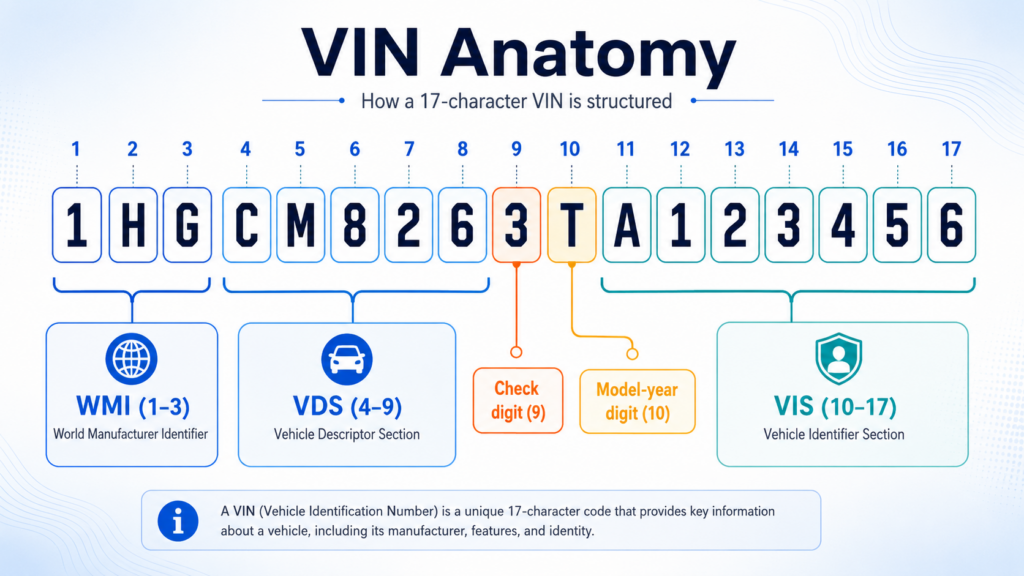
You don’t have to decode this by hand. A free tool like the NHTSA VIN decoder reads it all for you in seconds.
Where to find your VIN
Your VIN shows up in more than one place, which is handy if one is hard to read:
- The dashboard, on the driver’s side, visible through the windshield.
- The driver’s-side door jamb, on a sticker where the door latches.
- Your vehicle registration and title.
- Your insurance card and policy documents.
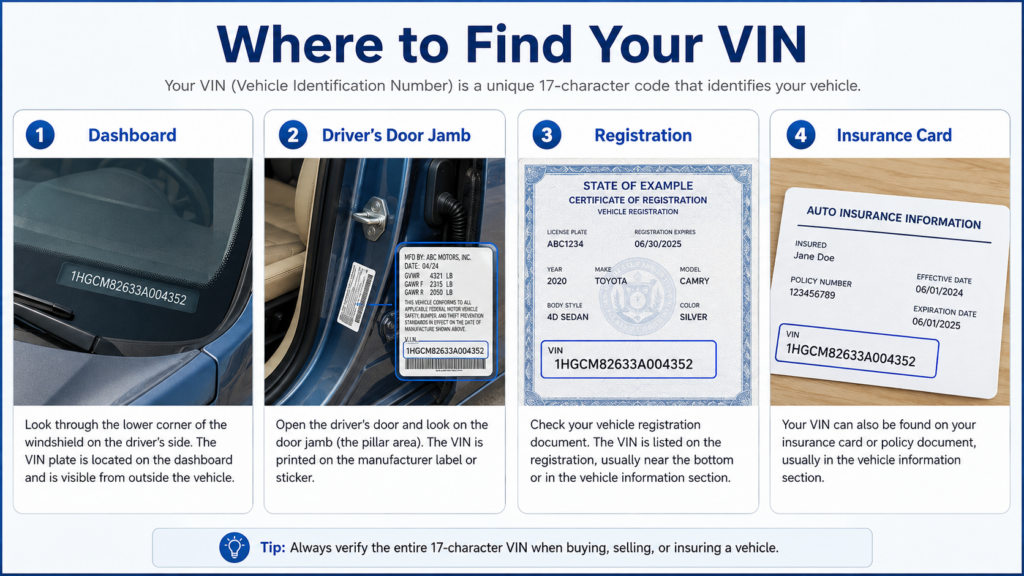
What you can actually do with a VIN
Once you have the VIN, it opens a few different doors depending on what you need:
- Decode the specs and check recalls, for free, with the NHTSA VIN decoder.
- Check accident and ownership history with a paid report like CARFAX.
- Get a resale offer in minutes using a tool like Carvana’s Sell My Car.
- Compare every option in our guide to the best VIN decoders and lookup tools.
The bottom line
A VIN is your car’s permanent, one-of-a-kind 17-character ID. It tells you what the car is, ties it to its recalls and paperwork, and acts as the starting point for decoding specs, checking history, or getting a resale offer. Learn where yours is and you’ll have everything you need to look the car up in seconds.
FAQ
Seventeen, for any car built since the 1981 model year. Older vehicles sometimes have shorter VINs in different formats.
Yes. Every car, truck, motorcycle, and trailer built for road use is assigned one.
No. A VIN is unique to a single vehicle. If you see two cars with the same VIN, that’s a red flag for fraud or “VIN cloning.”
No. A license plate is tied to the registration and can change or be transferred. The VIN is permanent and stays with the car for life.
Through the windshield on the driver’s-side dashboard, or on your insurance card if you can’t get to the car.