



Used Car Merchandising: The End-to-End Workflow That Gets Cars Online Faster
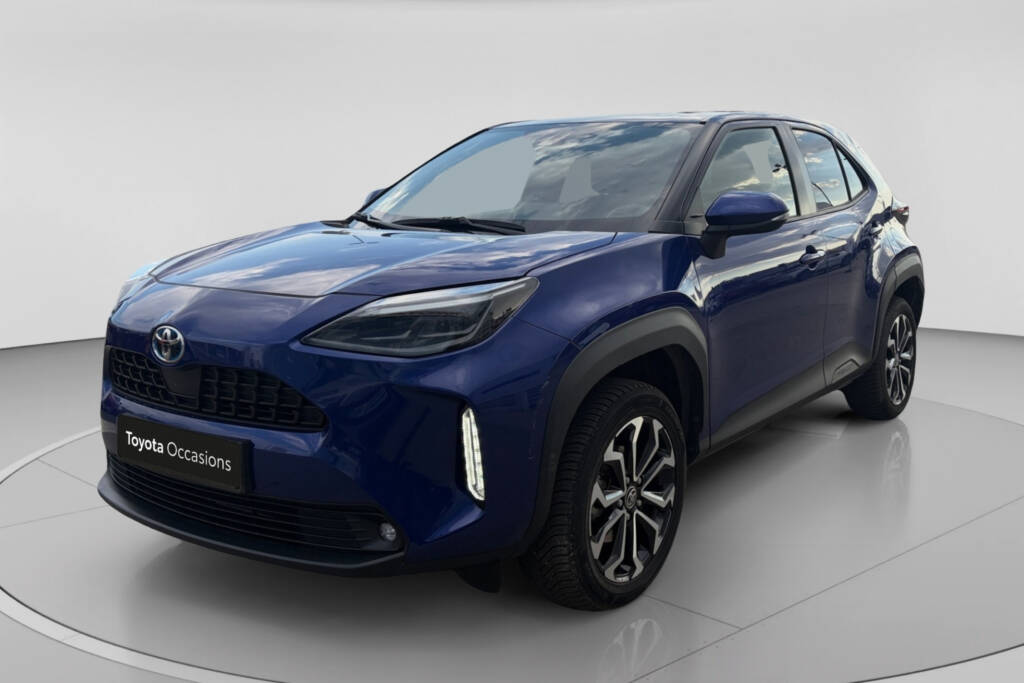
Used car merchandising is the operational process of turning a physical vehicle into a complete, trustworthy online listing—capturing and processing the photos, spins, and details that appear on your Vehicle Detail Page (VDP) and search results page (SRP), then syndicating them to every channel where shoppers look. Done well, it is the fastest lever a used-vehicle department controls: it decides how quickly a reconditioned car starts working for you online, and how convincingly it competes once it gets there.
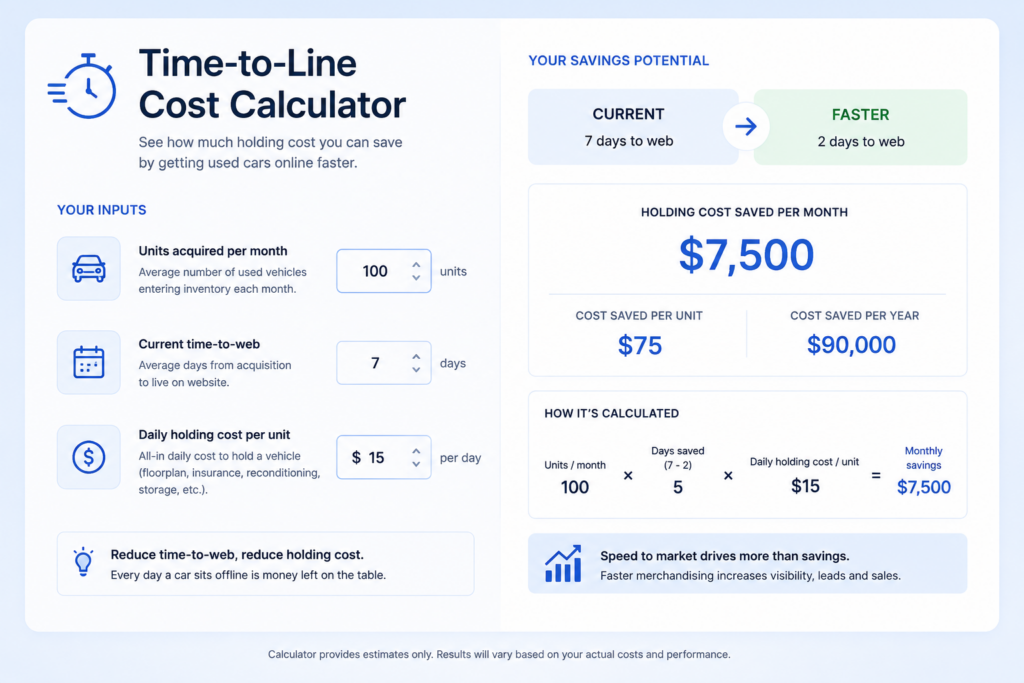
The problem most stores face is not knowing that photos matter. It is the gap between when a car is physically frontline-ready and when it is digitally frontline-ready. That gap—usually caused by a manual photo-and-editing bottleneck—quietly adds days to your time-to-line and dollars to your holding cost on every unit. This guide maps the full workflow, shows where the delay hides, and explains how to remove it.
Key takeaways
- Merchandising is a pipeline, not a photo shoot. It runs from acquisition through recon, capture, processing, QA, syndication, and finally the live VDP.
- The bottleneck is usually processing, not shooting. Editing, background work, and manual uploads add days after the car is already clean.
- Slow visuals are an invisible tax. Every day a retail-ready car sits without a full ad accrues holding cost while it earns nothing.
- Automation compresses the media portion of time-to-line—not recon. It cannot fix mechanical delays, but it can remove the editing queue.
What is used car merchandising?
Used car merchandising is the end-to-end workflow that converts a used vehicle into a complete online listing and distributes it across your website, SRP, and third-party marketplaces. It covers the visual assets (exterior and interior photos, 360° spins, feature callouts, video) and the descriptive data (VIN-decoded specs, condition notes, pricing) that a shopper uses to evaluate a car before contacting the store.
It is distinct from two adjacent activities. Reconditioning makes a car physically ready to sell; merchandising makes it digitally ready to shop. Automotive advertising decides where and how much you promote a listing; merchandising decides whether that listing is worth clicking when a shopper arrives. Getting merchandising right is what makes recon and ad spend pay off.
Why merchandising decides how fast a car turns
A used car earns nothing until shoppers can find it, trust it, and act on it online. Two forces make that urgent.
First, holding cost runs continuously. According to NADA and NCM estimates cited by VAN, the average carrying cost has been put at roughly $40 per vehicle per day, so a 12-day time-to-line works out to about $480 per unit before it is even listed. Treat that $40 figure as a conservative floor: it reflects a 2018 industry estimate, and with today’s higher floorplan interest rates your real carrying cost is likely higher. The safest way to use it is to plug in your own daily number—the direction is fixed either way: every idle day is money spent on a car that isn’t selling.
Second, shoppers increasingly transact on the strength of the listing itself. In Cox Automotive’s Evolving Consumer Study, 60% of consumers said they would buy sight unseen from a manufacturer’s website when backed by a no-questions-asked return policy. The trust that used to require a lot visit now has to be built by your visuals. (How to build that digital trust—AI backgrounds, staged scenes, and interactive spins—is covered in depth in our guides to the virtual car showroom and the 360 automotive walkaround.)
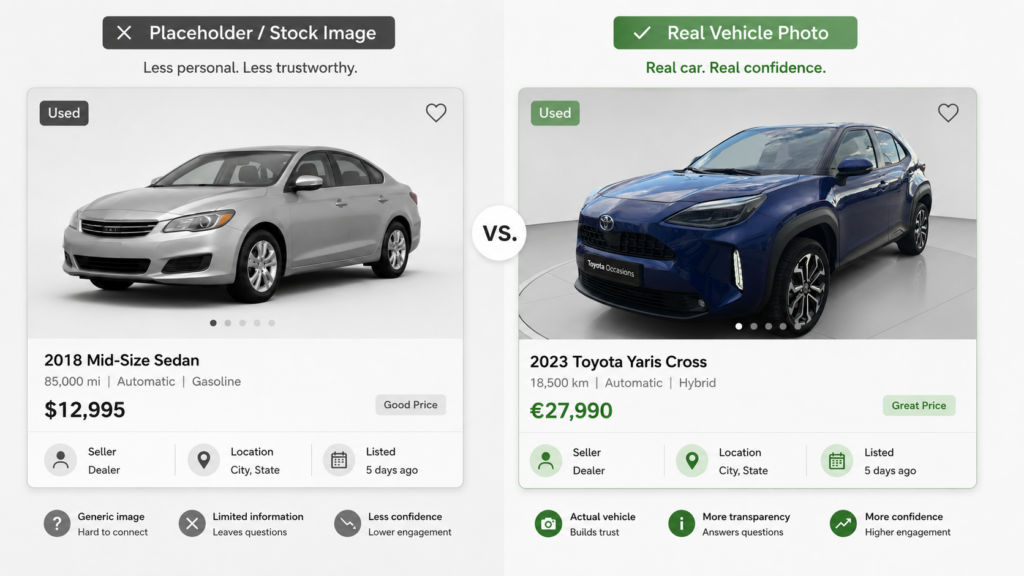
The quality of what you publish moves the numbers, too. One inventory-management vendor reported up to a 185% lift in VDP engagement when a listing’s stock or placeholder image was replaced with a real photo of the actual vehicle. Treat that as a vendor case-study figure rather than a guaranteed result, but the mechanism is sound: real, complete visuals give shoppers a reason to engage.
The invisible tax: slow time-to-line
Most stores measure time-to-line (T2L) as the days from acquisition to frontline-ready. But there is a second clock most dashboards miss: the days between physically ready and digitally ready—when a clean, recon-complete car sits in a corner of the lot waiting to be photographed, edited, and uploaded.
That waiting period is an invisible tax. The car is accruing holding cost every day, it is absent from your SRP, and every competitor unit that is already online is capturing the searches yours can’t. Nobody signs off on this cost, which is exactly why it persists—it never appears as a line item. It shows up instead as slightly worse days-to-turn across the whole department.
The tax is almost always concentrated in one place: processing. Shooting a car takes minutes. What takes days is the queue behind the camera—exporting images, cropping and color-correcting, editing or replacing backgrounds, writing descriptions, and manually pushing everything to the inventory management system (IMS), DMS, and marketplaces. When one person or one vendor owns that queue, it becomes a single point of failure for the entire lot.
The end-to-end used car merchandising workflow
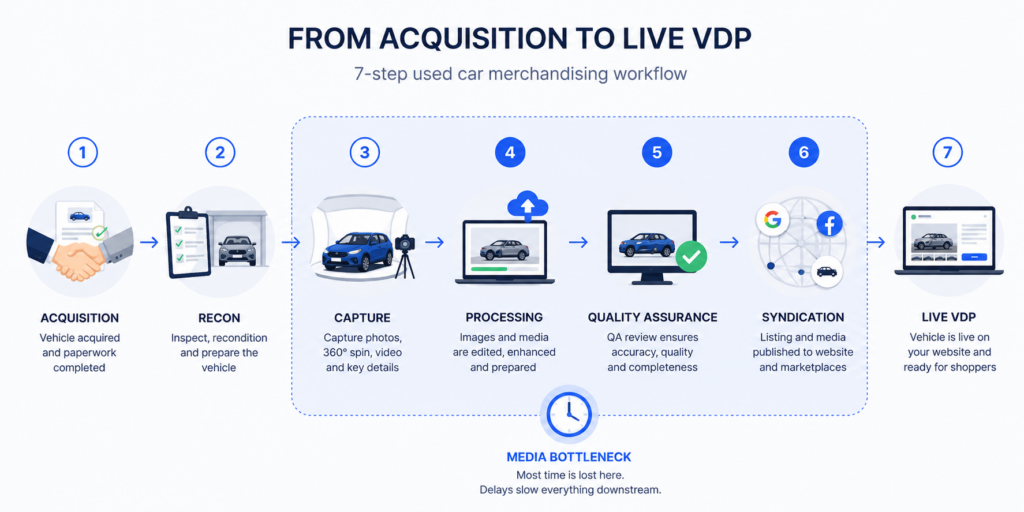
Here is the full pipeline, in order. Each stage has prerequisites and a clear completion criterion, so you can see exactly where cars stall.
Prerequisites before you start
- A defined shot list per body style (what angles, how many, interior vs. exterior).
- A capture standard (lighting, backdrop or location, framing).
- A named owner for each stage and a way to track a car’s status.
- IMS/DMS access so a captured car maps to the right stock number and VIN.
Step 1 — Acquisition and staging
Action: When a car arrives via trade or auction, log it and stage a “coming soon” placeholder so it is discoverable online immediately, even before full media exists. Give coming-soon listings a clear status, no firm price commitment, and a target live date—and set a rule that they convert to full media within your time-to-web SLA, so placeholders never become permanent. Completion criterion: The unit exists in your IMS with a stock number and a clearly labeled coming-soon listing on the SRP.
Step 2 — Reconditioning
Action: Complete mechanical inspection, repairs, and detail. This is where most of T2L is legitimately spent. Completion criterion: The car is physically frontline-ready and clean enough to photograph. Note: automation cannot compress this stage—it is mechanical work.
Step 3 — Capture
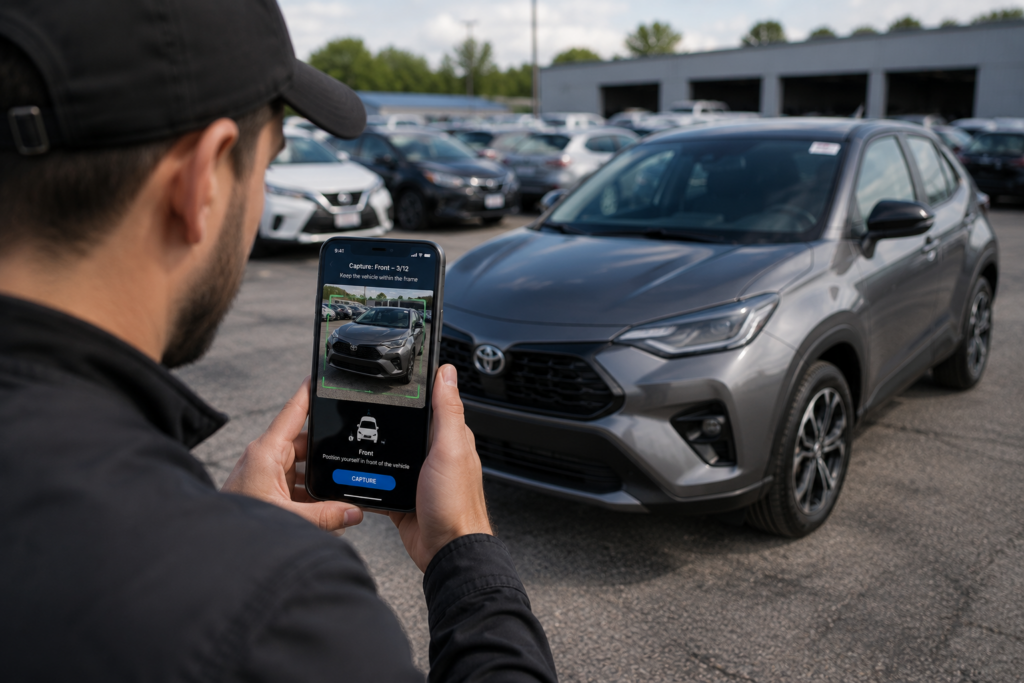
Action: Photograph the car against your standard shot list, ideally the moment it leaves detail. A lot attendant with a guided mobile app—not a professional photographer—should be able to do this consistently. Scan the VIN or barcode to bind the media to the correct stock number automatically. Completion criterion: A complete, correctly framed set of exterior/interior images (and 360° spin, if used) is captured and tied to the VIN.
Step 4 — Processing
Action: Crop, color-correct, apply consistent framing, and handle backgrounds. This is the historical bottleneck when done manually. Completion criterion: Every image meets your presentation standard and is ready for review.
Step 5 — Quality assurance and approval
Action: Review for missing shots, wrong VIN matches, poor framing, or reused images. For multi-rooftop groups, this is where brand consistency and governance are enforced. Completion criterion: The media set is approved and locked to the correct unit.
Step 6 — Syndication
Action: Publish approved media and data to your website, SRP, and third-party marketplaces simultaneously. Completion criterion: The full listing is live everywhere shoppers search, with images and data in sync.
Step 7 — Live VDP and monitoring
Action: Confirm the VDP renders correctly and track engagement and time-to-web (how long from capture to live listing). Completion criterion: The VDP is complete and measurable, and the unit is in your time-to-web reporting.
Where automation removes the bottleneck
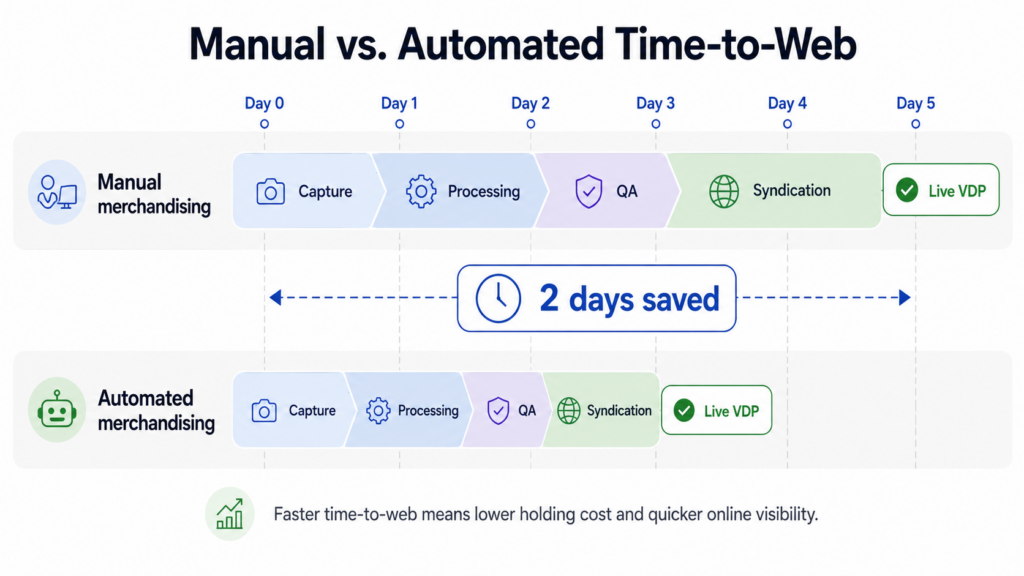
Automation targets one specific segment of the pipeline: the media-processing and publishing steps (3 through 6). It does not touch recon, and it will not fix a mechanical backlog. Understanding that boundary is what keeps expectations realistic.
Within the media portion, the goal is to eliminate the manual editing queue that turns a five-minute shoot into a multi-day delay. A structured visual pipeline typically does this in three ways:
- Guided capture at the source. A mobile app with smart framing, shot-list templates tied to your IMS/DMS, VIN/barcode scanning, and real-time quality checks lets a lot attendant capture publish-ready images the first time—reducing rework and reshoots. Offline capture with automatic upload keeps a weak-signal back lot from stalling the process.
- Automated processing. Background segmentation and consistent framing are applied automatically instead of image-by-image in an editor, which is what removes the days that pile up in the processing queue. (Advanced options such as AI-generated scenes and 3D environments are a merchandising presentation choice covered in the virtual car showroom guide.)
- Central library, QA, and automatic publishing. A hub that holds all media with role-based approval workflows, bulk actions, reprocessing, and multi-location controls lets a group enforce one standard everywhere—then syndicate approved listings to inventory systems and websites through integrations and APIs, without manual re-uploading.
This is the layer CarCutter is built for: a guided mobile capture app, automated background processing, and CarCutter Hub as the central media library with QA, roles, bulk reprocessing, and time-to-web analytics, plus API-based publishing. The point is not more software—it is removing the human editing queue that sits between “car is clean” and “car is live.”
A practical example
A store acquires a trade-in on Monday and finishes recon Wednesday afternoon. Under a manual process, the car waits for the photographer’s next scheduled shoot Thursday, the images go to an editor, and the finished listing publishes Saturday—two extra days of holding cost, and two days absent from the SRP.
With capture built into the recon exit, a lot attendant shoots the car Wednesday afternoon using a guided app, processing is automated overnight, QA approves Thursday morning, and syndication pushes the full listing live Thursday. The recon timeline didn’t change—only the media portion did—but the car is online two days sooner and stops accruing the invisible tax.
Tradeoffs and limitations
- Automation compresses media, not mechanics. If recon is your real constraint, fix that first; a faster photo pipeline won’t help a car stuck in the shop.
- Standards require upfront work. Shot lists, capture standards, and QA rules take effort to define. Skipping this step just moves inconsistency downstream.
- Change management is real. Moving capture to lot staff needs training and clear ownership, or cars will still stall waiting for “the photo person.”
- Governance matters more at scale. Single rooftops can run lean; multi-rooftop groups need role-based approvals and brand controls, or consistency drifts store to store.
- Tooling is a means, not a guarantee. Software removes the queue, but only measured, enforced process turns that into faster days-to-turn.
How to measure whether it’s working
Track two clocks side by side:
- Time-to-line (T2L): acquisition to physically frontline-ready. Owned mostly by recon.
- Time-to-web: capture to live, complete VDP. Owned by merchandising—and the metric automation should move.
Then watch the downstream signals: days-to-turn, VDP engagement, and the share of listings that go live with complete, real media rather than placeholders. For multi-rooftop groups, compare time-to-web across rooftops to expose where the process—or a single bottleneck—is breaking. (Where and how much you then promote those listings is a separate discipline; see automotive dealership marketing.)
Your next step
Start by measuring your time-to-web on the last 30 units and finding the stage where cars actually stall. If the delay lives in processing and publishing rather than recon, that is the media bottleneck—and it is the most fixable part of the pipeline.
If you want to see how an automated capture-to-syndication workflow would fit your current process, explore CarCutter and bring your own time-to-web numbers to the conversation.
FAQ
No. Reconditioning makes a car physically ready to sell; merchandising makes it digitally ready to shop—capturing, processing, and publishing the visuals and data on the VDP. They run back-to-back but are different stages with different owners.
Usually not. With a guided capture app that enforces a shot list and checks quality in real time, a trained lot attendant can produce consistent, publish-ready images. The bigger constraint is process ownership, not photography skill.
Time-to-line measures how long until a car is physically frontline-ready. Time-to-web measures how long until it’s live online with a complete listing. Automation mainly targets time-to-web by removing the media-processing delay.