



The Best Software for Car Dealerships in 2026
Well this may be an odd way to start this article given its title, but there is no single best software for car dealership technology stack. The right platform in each category depends on your dealership’s size, the vendor ecosystem you already rely on, and the specific commercial problem you are trying to solve. This buyer’s guide compares some of the leading options across the seven technology categories that most affect dealership performance: dealer management systems, CRM, inventory and pricing, vehicle merchandising, websites and digital retailing, desking and F&I, and marketing and customer communication.
How to use this software for car dealerships guide
Most dealerships do not replace their entire software stack at once. They fix the weakest link. For each category below you will find:
- The commercial problem the category solves.
- Three representative platforms, chosen to cover the safe incumbent, a differentiated alternative, and a modern challenger.
- A plain-language “choose this when” recommendation for each.
- A category pick to anchor your shortlist.
TL;DR: The definitive software for car dealerships stack for 2026
| Category | Top-tier pick | Why this one |
|---|---|---|
| DMS | CDK Global | The safest enterprise backbone for large franchise and multi-rooftop operations. Broad front- and back-office coverage, the Fortellis integration ecosystem, and a large U.S. footprint that makes staffing easier. Chosen when operational breadth and established integrations outweigh the pull of a lighter, more modern UX. |
| CRM | VinSolutions | The deepest data-and-reporting CRM, built around a single customer record with strong management visibility and access to Cox Automotive shopper and inventory signals. The default when reporting depth and Cox connectivity anchor your commercial strategy. |
| Inventory, appraisal & pricing | vAuto | The established benchmark, reported in use by 14,000+ dealerships, with mature workflows across appraisal, acquisition, pricing, ageing, and wholesale, plus ProfitTime GPS discipline. Chosen when you want a proven inventory operating system backed by extensive benchmarking. |
| Vehicle merchandising | CarCutter.com | The strongest fit for scalable, brand-controlled visual quality across rooftops. It treats photography as a repeatable inventory operation with guided mobile capture with real-time AI checks, AI background processing and 360° experiences, and the CarCutter Hub for centralized governance, QA, and time-to-web analytics. CarCutter also offers with API/IMS-DMS publishing straight to inventory and websites. Chosen when consistent visual quality and faster merchandising across a group are the priority. |
| Website & digital retailing | Dealer.com | The lower-risk enterprise storefront, combining websites, advertising, merchandising, and digital retailing with deep Cox Automotive connectivity and proven multi-rooftop scale. Chosen when ecosystem connectivity and OEM familiarity matter more than a fully bespoke site. |
| Desking, F&I & digital contracting | Dealertrack | The most complete end-to-end F&I transaction layer, connecting credit applications, lender communication, compliance, and digital contracting to minimize handoffs and re-keying. Chosen when transaction connectivity and lender-network breadth are the primary requirements. |
| Marketing, communication & analytics | Fullpath | The strongest engine for activating first-party data, unifying fragmented DMS, CRM, website, and marketing data into individualized, automated campaigns. Chosen when your core challenge is turning scattered customer data into scalable, personalized engagement. |
1. Dealer management systems (DMS)
The DMS is the operational backbone that connects accounting, inventory, sales, service, and parts. Switching one is the highest-stakes technology decision most dealerships make, so weigh continuity and integration breadth against modern usability.
CDK Global — the safe enterprise incumbent
Best for: Large franchise dealerships and multi-rooftop groups that want broad, established functionality.
CDK connects front-office and back-office operations, and its Fortellis marketplace extends access to third-party applications and APIs. Its large U.S. footprint also makes it easier to hire staff already familiar with the system.
- Strengths: Broad operational coverage, an extensive third-party ecosystem, and strong fit for complex, multi-department franchise operations.
- Trade-offs: Administration and workflows can feel complex for smaller stores, and cost, support, and usability receive mixed dealer feedback. The 2024 cyber incident that disrupted roughly 15,000 dealership locations is also a reminder of the business-continuity risk of concentrating critical operations in one provider.
Choose CDK when you need the broadest established ecosystem and cannot risk discovering a specialized workflow is missing.
Reynolds & Reynolds ERA-IGNITE — best for process control
Best for: Franchise dealerships that prioritize accounting rigor and tightly connected, standardized operations.
ERA-IGNITE connects customer, vehicle, and transaction information across departments, with consistent identifiers that reduce fragmented records.
- Strengths: Strong accounting, service, parts, and transaction management; structured processes that support governance across departments.
- Trade-offs: More screens and process steps than newer cloud-native tools, and a substantial learning curve for new employees. Evaluate API openness, data-export rights, and integration costs carefully.
Choose Reynolds when operational discipline and standardized processes matter more than interface simplicity.
Tekion — the modern transformation candidate
Best for: Growth-oriented groups seeking a cloud-native alternative to traditional DMS platforms.
Tekion positions its Automotive Retail Cloud as a unified platform spanning DMS, CRM, digital retail, service, parts, and analytics — with the possibility of replacing several disconnected systems with one real-time cloud platform.
- Strengths: Modern cloud architecture, real-time data and AI-assisted workflows, and the potential to reduce the number of separate applications.
- Trade-offs: Migration from a legacy DMS can require significant process change, training, and data cleanup, and some evaluations note uneven module maturity. Confirm every OEM, lender, accounting, and state-specific workflow is supported before committing.
Choose Tekion when you will accept more transformation risk in exchange for a unified, modern platform.
Category pick: CDK for the safest enterprise incumbent, Reynolds for structured operational control, Tekion for a modern transformation.
2. CRM and lead management
A CRM’s job is to capture every lead, preserve customer history, and drive consistent follow-up. The best choice often depends less on features than on which ecosystem you are in and whether your salespeople will actually use it.
VinSolutions — best data and reporting depth
Best for: Dealerships that want a mature automotive CRM with strong reporting and Cox Automotive data connections.
VinSolutions is one of the best crm software for car dealerships. It organizes lead management, customer history, follow-up, and reporting around a single customer record, with connectivity to Cox products such as Dealer.com, Autotrader, and Kelley Blue Book.
- Strengths: Comprehensive activity tracking, strong management visibility, and access to Cox shopper and inventory signals.
- Trade-offs: Some users find the interface click-heavy, and performance can slow during busy periods. The advantage is greatest for dealers already in the Cox ecosystem.
Choose VinSolutions when reporting depth and Cox connectivity are central to your strategy.
CDK CRM — best fit for CDK dealerships
Best for: CDK dealerships that want sales, BDC, service, and customer workflows connected to their core platform can’t go wrong with this crm software for car dealerships.
Drawing on the Elead lineage, CDK CRM connects customer interactions across sales, service, and marketing, with the primary advantage of operational continuity for existing CDK customers.
- Strengths: Native alignment with the CDK DMS, support for BDC and lifecycle management, and reduced data-synchronization complexity for CDK customers.
- Trade-offs: Possible module overlap and legacy workflow complexity. Test mobile usability and modern messaging directly with salespeople, and check references on support and configuration.
Choose CDK CRM when your DMS strategy is already centered on CDK and you value native alignment over best-of-breed independence.
DriveCentric — best for adoption and modern engagement
Best for: Dealerships whose main problem is low salesperson adoption and inconsistent follow-up.
DriveCentric is a crm software for car dealerships that differentiates through a modern interface with integrated messaging, video, automation, and AI-assisted engagement, and reports serving more than 2,200 dealerships.
- Strengths: User-friendly interface; email, SMS, and video inside the sales workflow; strong emphasis on response speed and AI-assisted follow-up.
- Trade-offs: Needs clear governance for lead ownership, duplicates, and automation rules, and AI-generated communication still requires brand, compliance, and escalation controls.
Choose DriveCentric when sales adoption and speed-to-lead matter more than elaborate reporting.
Category pick: VinSolutions for data and reporting depth, CDK CRM for CDK dealerships, DriveCentric for user adoption.
3. Inventory acquisition, appraisal, and pricing
These software for car dealerships decide what you stock, what you pay, and how you price — the levers that most directly protect used-vehicle margin. Choose based on how much of the acquisition-to-wholesale journey you want in one system.
vAuto — the established benchmark
Best for: Dealers who want the most established inventory-management methodology.
vAuto remains one of the most influential U.S. inventory platforms, reporting usage by more than 14,000 dealerships, with products covering appraisal, acquisition, pricing, stocking, ageing, and wholesale decisions; ProfitTime GPS adds a structured approach to each vehicle’s investment potential.
- Strengths: Extensive market and pricing data, mature workflows, a large installed base, and strong inventory-age reporting.
- Trade-offs: Pricing can be high versus newer challengers, and managers can become over-reliant on algorithms at the expense of local demand and vehicle condition.
Choose vAuto when you want a proven inventory operating system backed by extensive benchmarking and management discipline.
ACV MAX — best acquisition-to-wholesale software for car dealerships
Best for: Used-vehicle departments that want acquisition, inspection, pricing, and wholesale closely connected.
ACV MAX combines inventory intelligence with ACV’s appraisal, condition-reporting, and wholesale marketplace ecosystem, with increasingly prominent AI-based recommendations.
- Strengths: Connects acquisition through disposal, benefits from ACV’s auction and condition-report infrastructure, and surfaces vehicle-level margin and ageing risks.
- Trade-offs: Value is greatest for dealers using multiple ACV products, independent large-sample reviews are less extensive than vAuto’s, and results require disciplined appraisal inputs.
Choose ACV MAX when wholesale connectivity and condition-informed acquisition matter as much as retail pricing.
VINCUE — the consolidation challenger
Best for: Independent and franchise dealers seeking a modern, cost-conscious alternative.
VINCUE combines appraisal, acquisition, pricing, inventory management, and merchandising workflows, and says its market analysis draws from tens of thousands of dealer websites.
- Strengths: End-to-end workflow, a flexible and cost-conscious position, modern repricing tools, and the potential to replace multiple point solutions.
- Trade-offs: Smaller ecosystem and installed base than vAuto. Test market-data coverage for your exact geography and verify integration parity with your DMS, website, and auction partners.
Choose VINCUE when you want modern inventory functionality without automatically accepting incumbent pricing.
Category pick: vAuto for the established benchmark, ACV MAX for acquisition-to-wholesale, VINCUE for a consolidation challenger.
4. Vehicle merchandising and inventory distribution
Merchandising turns vehicles in your lot into compelling online listings. Because shoppers form impressions from photos before they read a word, image quality, consistency, and time-to-market directly affect VDP engagement and lead quality. Just as with any other software for car dealerships, choose based on whether you need focused visual production or a broader engagement suite.
CarCutter — The best software for car dealerships for visual quality and standardization across groups
Best for: Dealer groups needing fast, standardized, and high quality vehicle imagery across multiple rooftops.
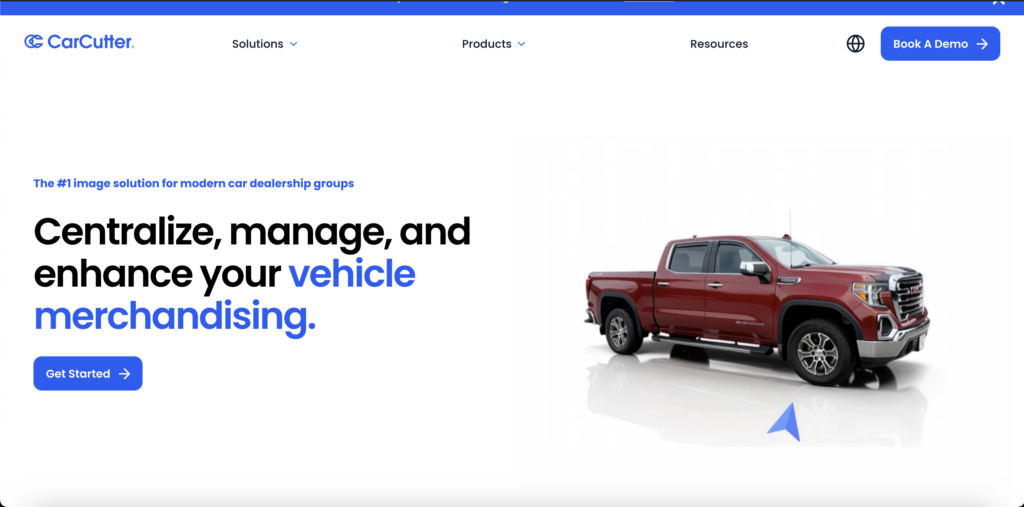
CarCutter is a software for car dealerships that focuses on the visual-production workflow: guided image capture, AI enhancement, background replacement, virtual showrooms, 360° car spin generation (which carcutter can generate form only 4 pictures), centralized management, and publishing. It currently serves more than 4,000 dealer groups across nearly 20 countries, making it a leader in terms of global footprint. Its strongest fit is a group that treats photography not as a creative task but as a repeatable inventory operation with measurable time-to-market and quality standards.
In practice, that operating model shows up across the workflow: a mobile capture app (iOS and Android) with smart framing, shot-list templates, and real-time AI quality checks; AI backgrounding, true 3D showroom scenes, realistic shadows and reflections, Hotspots, and license-plate handling; backgrounded 360° exterior spins delivered through a lightweight web player; and the CarCutter Hub for a centralized media library, roles and multi-location controls, QA and approval workflows, and time-to-web analytics. Image, Feature, Vehicle, and Admin APIs plus IMS/DMS ingestion support automatic publishing to inventory systems and websites.
- Strengths: Specialized automotive image capture and enhancement, centralized governance for consistent output across rooftops and brands, and a 360° workflow designed to create interactive views from a small number of captured images. Unmatched output quality. No need for extra equipment or training.
- Trade-offs: More specialized than broad customer-engagement platforms, so dealers may still need separate CRM, chat, and digital-retailing tools.
Choose CarCutter when your priority is scalable, centrally controlled visual identity and faster high quality merchandising across a dealership group.
Impel — best for broad merchandising-and-engagement suite
Best for: Dealers wanting vehicle merchandising and AI-powered customer engagement from one provider.
Impel’s merchandising suite includes virtual photo booths, feature tours, and video, while the wider platform extends into conversational AI and lifecycle engagement.
- Strengths: A suite that extends beyond imagery into engagement, and suitability for enterprise dealers and OEM programs.
- Trade-offs: The breadth may be excessive, and very expensive, for a dealership group that is focused on merchandising, and implementation grows quite complex when several modules are adopted at once, especially in multi-rooftop dealership groups.
Choose Impel when you feel comfortable sacrificing image quality and time to market for a broad used platform spanning merchandising and AI-assisted engagement.
Spyne — best for box ticking
Best for: Independent dealers and cost-sensitive groups wanting accessible, self-service AI merchandising.
Spyne offers a software for car dealerships that includes basic AI background replacement, virtual studios, image enhancement with positioning that emphasizes automation, rapid processing, and ease of use for dealers without professional studios.
- Strengths: Accessible AI-based solution, low infrastructure requirement versus physical booths, and an easy start.
- Trade-offs: Reviews suggest quality-control turnaround and image accuracy can vary. Enterprise buyers should validate support coverage, SLAs, and large-group administration, and dealers with strict OEM standards should test output consistency across a representative sample.
Choose Spyne when you need an approachable, lightweight AI merchandising system that prioritizes quantity over quality, and if you are prepared to perform some quality review.
Category pick: CarCutter for visual quality and standardization across groups, Impel for a broad merchandising-and-engagement suite, Spyne for accessible self-service.
5. Website and digital retailing
Your website is the storefront where merchandising, pricing, and financing converge into leads and online transactions. In some ways, it is the software for car dealerships that represents your physical lot online. Choose based on how much you value ecosystem connectivity versus design and experience differentiation.
Dealer.com — the enterprise ecosystem choice
Best for: Franchise dealerships wanting a large, established platform connected to Cox Automotive.
Dealer.com combines websites, advertising, inventory merchandising, and digital retailing, with integration into Autotrader, Kelley Blue Book, and other Cox properties.
- Strengths: Broad capability combination, strong Cox connectivity, established OEM experience, and support for complex multi-rooftop organizations.
- Trade-offs: Ecosystem dependence and switching costs, bundled pricing that is hard to compare, and website differentiation that depends heavily on configuration.
Choose Dealer.com when you want a lower-risk enterprise platform and already rely on Cox Automotive.
Dealer Inspire — best design and digital experience
Best for: Dealers prioritizing design quality, SEO, and a flexible customer journey.
Dealer Inspire combines websites with digital retailing, prequalification, messaging, SEO, and advertising, and is certified across a broad range of OEM programs.
- Strengths: Strong design and UX, integrated digital-retail and financing journeys, and established automotive SEO expertise.
- Trade-offs: OEM requirements can constrain design flexibility, and third-party scripts can undermine performance. Establish clear ownership of analytics and conversion tracking.
Choose Dealer Inspire when website experience and digital-retail usability are key differentiators.
DealerOn — the focused website-and-commerce challenger
Best for: Dealers wanting a unified website, SEO, advertising, and native digital-retailing platform.
DealerOn’s Cosmos website platform combines with search marketing, SEO, and Apex digital retailing, keeping inventory discovery and purchase progression within one connected experience.
- Strengths: Website, SEO, paid media, and digital retail in one product family; strong emphasis on site performance and conversion; support for dealer-group structures.
- Trade-offs: No consumer-data ecosystem on the scale of Cox. Validate support and optimization with similar dealer references, and test all integrations with real workflows before signing.
Choose DealerOn when you want a focused automotive web and commerce platform without entering a large vendor ecosystem.
Category pick: Dealer.com for the enterprise ecosystem, Dealer Inspire for design and experience, DealerOn for a focused challenger.
6. Desking, F&I, and digital contracting software for car dealerships
This layer moves a deal from agreed price through credit, lender submission, contracting, and compliance. As far software for car dealerships go, this one is mostly meant to minimize handoffs and re-keying. Choose based on whether you need end-to-end transaction breadth, finance-source connectivity, or better product presentation.
Dealertrack — best end-to-end F&I transaction platform
Best for: Dealerships needing comprehensive credit, lender, compliance, and digital-contracting workflows.
Dealertrack connects credit applications, lender communication, compliance, and digital contracting, acting as a central transactional layer between dealerships and finance sources.
- Strengths: Extensive lender connectivity, broad credit/compliance/eContracting coverage, and reduced repeated data entry.
- Trade-offs: Complexity when multiple products are bundled, and eContracting availability that differs by lender, state, and transaction. Compare transaction and implementation fees, not just subscription price.
Choose Dealertrack when end-to-end transaction connectivity and lender-network breadth are your primary requirements.
RouteOne — best finance-source and eContracting hub
Best for: Dealers prioritizing finance-source connectivity, credit workflow, and electronic contracting.
RouteOne provides a common interface between dealerships and finance sources, including credit applications, lender decisions, eContracting, and remote signing, with a Connection Hub that clarifies which functions each finance source supports.
- Strengths: Strong finance-source connectivity, established eContracting and remote signature, and frequent lender updates.
- Trade-offs: Not a substitute for a DMS, CRM, or desking system, with functionality that varies by finance source. You may still need separate menu, titling, or deal-analytics tools.
Choose RouteOne when finance-source communication and eContracting matter more than covering the entire retail stack.
J.D. Power Darwin Automotive — best F&I product-presentation layer
Best for: Dealers focused on improving F&I product presentation, personalization, and penetration.
Darwin specializes in the F&I presentation layer, using customer and transaction data to support personalized menu recommendations, pricing, contracting, and signing across in-store and digital journeys.
- Strengths: Strong menu and product-presentation capabilities, support for online and in-store journeys, and personalized recommendations; integrates with Dealertrack’s eMenu workflow.
- Trade-offs: Does not replace lender, credit, or DMS infrastructure, and results depend on correct configuration, training, and compliance controls. Evaluate incremental gross against the full platform and training cost.
Choose Darwin when your biggest opportunity is improving F&I product presentation and penetration rather than lender connectivity.
Category pick: Dealertrack for end-to-end F&I, RouteOne for finance-source and eContracting, Darwin for product presentation.
7. Marketing, customer communication, and analytics car dealerships software
These three platforms are not direct substitutes, they solve different commercial problems. Fullpath is primarily a customer-data and marketing-activation software for car dealerships, automotiveMastermind is a predictive sales-intelligence platform, and Podium is primarily a customer-communication and AI-assisted BDC platform. The right pick depends on your clearest revenue leak.
Fullpath — best for customer-data activation
Best for: Dealer groups seeking to unify customer data and automate individualized marketing.
Fullpath’s Customer Data and Experience Platform connects dealership data sources, builds customer profiles, and activates audiences through automated campaigns — turning fragmented DMS, CRM, website, and marketing data into individualized engagement.
- Strengths: Combines data unification with activation, supports automated audience-specific marketing, and uses an automotive-specific data model.
- Trade-offs: Depends on data cleanliness and identity resolution, can overlap with CRM automation and existing CDP functions, and typically requires several weeks to implement. Agree attribution definitions before launch.
Choose Fullpath when activating fragmented first-party customer data at scale is your primary challenge.
automotiveMastermind — best for predictive sales opportunities
Best for: Dealerships focused on owner retention, equity mining, conquest, and service-to-sales.
automotiveMastermind uses predictive data and market signals to identify customers likely to purchase or replace a vehicle, giving sales teams prioritized opportunities rather than manual CRM searches; it is supported by S&P Global Mobility data.
- Strengths: Predictive prioritization, strong equity and lease-maturity use cases, and structured daily opportunities.
- Trade-offs: A sales-intelligence overlay, not a full CRM or communications hub, with value dependent on adoption and follow-up. Validate CRM write-back and workflow integration.
Choose automotiveMastermind when you have a valuable customer database but salespeople are not consistently working replacement opportunities.
Podium — best software for car dealership for communication and AI-assisted BDC
Best for: Dealerships seeking faster lead response, centralized communication, review generation, and AI-assisted appointment setting.
Podium consolidates conversations from text, phone, website chat, and social platforms, with automotive AI for lead response and appointment workflows, plus review and payment functionality.
- Strengths: Centralized conversation inbox, strong SMS and reputation-management capabilities, and AI that can respond to leads and schedule appointments after hours.
- Trade-offs: Not a complete CDP or attribution platform, with some reviews noting pricing or integration limits. AI conversations need clear escalation, consent, and CRM write-back rules to avoid a data silo.
Choose Podium when missed calls, slow lead response, and fragmented conversations are your clearest revenue leaks.
Category pick: Fullpath for customer-data activation, automotiveMastermind for predictive sales, Podium for communication and AI-assisted BDC.
Your 2026 software for car dealerships shortlist
The column labels are approximate: in several categories, the providers solve different versions of the same commercial problem rather than competing head-to-head.
| Category | Strongest incumbent | Differentiated alternative | Modern challenger |
|---|---|---|---|
| DMS | CDK | Reynolds & Reynolds | Tekion |
| CRM | VinSolutions | CDK CRM | DriveCentric |
| Inventory | vAuto | ACV MAX | VINCUE |
| Merchandising | CarCutter | Impel | Spyne |
| Website & retailing | Dealer.com | Dealer Inspire | DealerOn |
| Desking & F&I | Dealertrack | RouteOne | Darwin |
| Marketing & communication | Fullpath | automotiveMastermind | Podium |
Frequently asked questions
Fix your weakest link relative to your commercial goal. If leads leak from slow follow-up, prioritize CRM or communication tools; if used-car margin is thin, prioritize inventory and pricing; if VDPs underperform, prioritize merchandising.
Standardization improves governance, reporting, and brand consistency, and it lowers training cost — but confirm each platform supports multi-location roles, controls, and the OEM and state requirements of every rooftop before rolling it out group-wide.
Often yes. Dedicated merchandising software for car dealerships focus on capture consistency, AI enhancement, 360° presentation, and centralized quality control across rooftops, which general website tools rarely match. Test output quality and time-to-web against your current process during a pilot.
Deciding where merchandising fits in your 2026 stack? If faster, more consistent vehicle imagery across rooftops is on your shortlist, see how CarCutter’s capture-to-publish workflow works and run a pilot on your own inventory before you commit.