



SEO for Car Dealerships: How to Build and Run a Complete Program

SEO for car dealerships is the practice of organizing your website, content, inventory pages, and local presence so that search engines can find, understand, and surface the right pages to in-market shoppers. For a dealership, it is less a single project than an operating program that spans your website platform, vehicle detail pages, Google Business Profiles, and the way your team publishes and maintains all of them.
This guide provides a six-layer operating framework, a practical ownership model, responsible measurement principles, and a phased implementation plan. It also explains where specialist decisions—buying automotive SEO services, choosing automotive SEO software, and running local SEO for car dealers—fit into the wider program.
TL;DR
- Dealership SEO requires six connected layers: technical, content, local, inventory and VDP workflows, measurement, and governance.
- Every layer needs a named owner, clear responsibilities, and a process for resolving problems.
- Dealer groups should establish and test the operating model at one rooftop before expanding it.
- Inventory accuracy, complete VDP content, and time-to-web matter operationally, but they are not direct ranking factors.
- Google phased out Vehicle Listing structured data in organic Search in June 2025; this is separate from paid Vehicle Listing Ads.
- CarCutter supports the vehicle-media workflow, but it does not replace an SEO agency, CMS, or local-search platform.
What SEO for car dealerships actually covers
At its core, SEO is about helping people and search engines find genuinely useful content. Google’s foundational advice is to organize your site around people first and make important content easy to discover rather than chasing ranking tricks, as described in Google’s SEO Starter Guide and its guidance on helpful, reliable, people-first content.
For a dealership, that general practice applies to several areas most businesses do not manage at the same scale:
- A large, constantly changing inventory of vehicle detail pages, or VDPs.
- Search results pages, or SRPs, covering vehicle categories and filtered inventory.
- Multiple physical locations, departments, and sometimes several franchises.
- A media and merchandising pipeline that populates each VDP.
- Local search visibility for each rooftop.
This article defines the overall program and how its parts work together. It does not fully resolve three specialist decisions: how to procure outside help, which software capabilities to use, and how to execute local SEO. Those areas are covered in the accompanying specialist guides.
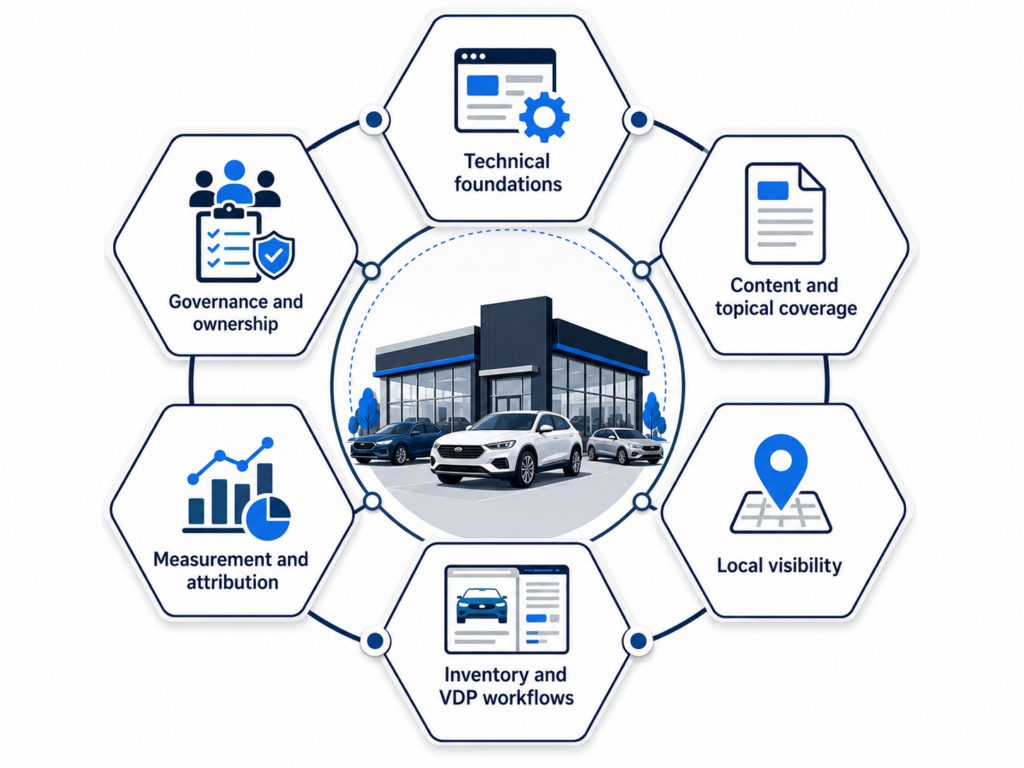
The six layers of a dealership SEO program
A dealership SEO program can be organized into six connected layers. Each layer has a distinct purpose, an accountable owner, and a way to assess whether it is working properly.
- Technical foundations: Can search engines crawl, render, and index your pages?
- Content and topical coverage: Do you answer the questions buyers and researchers ask?
- Local visibility: Can nearby shoppers find the correct rooftop or department?
- Inventory and VDP workflows: Are inventory pages crawlable, complete, and accurate?
- Measurement and attribution: Are you monitoring meaningful indicators without overclaiming?
- Governance and ownership: Does someone own each layer and maintain it over time?
Treat this as a practical method for organizing the work, not as a set of official Google requirements.
RACI-style ownership
The following model assigns responsibility and accountability to realistic dealership roles. In a lean dealership, one person may hold several roles.
| Layer | Responsible | Accountable | Consulted | Small-team fallback |
|---|---|---|---|---|
| Technical foundations | Website partner or platform administrator | Marketing manager | Digital retail lead | Marketing manager briefs and manages the platform or agency |
| Content | Content lead or agency | Marketing manager | Sales and service teams | Marketing manager scopes the work to an agency or freelancer |
| Local visibility | Local-listings owner | Marketing manager | Store managers | Marketing manager manages profiles centrally |
| Inventory and VDP workflows | Inventory or merchandising manager | Digital retail lead | Marketing manager | A trained lot or photo lead handles capture; marketing owns completeness and templates |
| Measurement | Analytics owner or agency | Marketing manager | CMO | Marketing manager maintains a focused Search Console and analytics review |
| Governance | Marketing manager | CMO | All operational owners | CMO and marketing manager hold a recurring review |
In a smaller dealership, one person may hold several roles. That is workable as long as the responsibilities remain visible and none of the six layers is unintentionally neglected.
Technical foundations for dealership websites
Technical SEO determines whether pages are eligible to appear in search. Eligibility for indexing generally requires that Googlebot is not blocked, the page returns a successful HTTP 200 response, and the page contains indexable content. Meeting those requirements does not guarantee indexing, as explained in Google’s Search technical requirements.
The main technical priorities for a dealership website include:
- Crawlability and site structure: Maintain a logical URL structure and internal linking so crawlers and shoppers can reach important SRPs, VDPs, service pages, and location pages.
- Duplicate URL control: Use canonical URLs to indicate preferred versions of duplicate or near-duplicate inventory pages. A canonical is a signal rather than an absolute instruction, according to Google’s canonicalization guidance.
- Mobile parity: Ensure that meaningful desktop content also appears on mobile. Google predominantly uses the mobile version of a page for indexing, as documented in Google’s mobile-first indexing guidance.
- Page experience: Treat Core Web Vitals as one part of the overall user experience, not as the primary or sole ranking factor. Google’s page experience guidance explains the wider context.
- Monitoring and diagnosis: Use Search Console’s indexing and URL inspection tools to identify crawling and indexing problems. These tools help diagnose issues; they do not prove causation or force a page to be indexed, according to Google’s Search Console documentation.
Content that serves dealership buyers and researchers
Automotive shoppers move through different information needs. They may begin with broad research, proceed to model and trim comparisons, and eventually search for a specific type of vehicle or dealership in their area.
Useful dealership content can include:
- Buying and financing guides.
- Model, trim, and feature explainers.
- Used-versus-new vehicle comparisons.
- Ownership and maintenance information.
- Service and repair content.
- Clear pages for each location and department.
- Vehicle-category pages serving meaningful shopper needs.
Write for the person making the decision. Demonstrate real automotive knowledge and make expertise and trust visible, following Google’s principles for helpful, reliable, people-first content.
The necessary depth should be determined by the reader’s question, not an arbitrary word count or keyword density.
Inventory, SRPs, and VDPs: the dealership-specific SEO surface
Inventory is usually the dealership website’s largest and most volatile group of pages. The operational objective is straightforward: each eligible vehicle should have a crawlable URL, complete and accurate page content, and media that helps the shopper evaluate it.
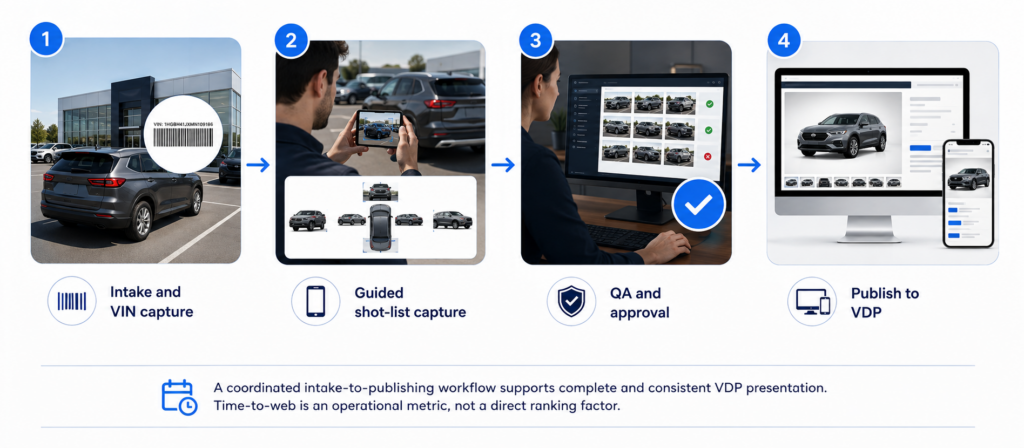
A practical VDP media and merchandising workflow follows this sequence:
- Vehicle intake and VIN capture.
- Shot-list-based image capture.
- Quality assurance and approval.
- Publishing the approved content and media to the VDP.
The inventory or merchandising manager should be accountable for this process. When that role does not exist, assign a trained lot or photo lead and make marketing accountable for content completeness and quality assurance.
Time-to-web—the time required for a vehicle to reach its published VDP—is an operational workflow metric. It is not a documented Google ranking factor.
Other practical recommendations include:
- Use crawlable and stable URLs for important VDPs and SRPs.
- Publish accurate specifications, pricing where appropriate, disclosures, and useful descriptive content.
- Keep website inventory aligned with vehicles that are actually available.
- Give vehicle images descriptive alt text and relevant surrounding context.
Making images crawlable, using descriptive alt text, and placing images near relevant text helps search engines understand the content and supports accessibility. These practices are included in Google’s image SEO guidance. The visual aesthetics of an image are not, by themselves, a documented ranking factor.
What changed with Vehicle Listing structured data
Dealers and vendors should avoid outdated structured-data advice. Google phased out support for Vehicle Listing structured data in organic Search in June 2025, as explained in Google’s announcement about simplifying Search results.
Google stated that the change did not affect how pages were ranked. It also applies to organic Search features and should not be confused with paid Vehicle Listing Ads or uses outside Google Search.
If a provider continues to sell Vehicle Listing markup as a current organic-search tactic, treat that as an indication that its recommendations may be outdated.
Where vehicle media fits
A media and merchandising workflow is one operational input to complete, consistent VDP content.
Tools in this category—including CarCutter—can support guided mobile capture, shot-list templates, real-time AI quality checks, VIN or barcode scanning, quality-assurance workflows, centralized media management, and automatic publishing through integrations.
CarCutter is a vehicle imaging and media-workflow layer, not an SEO platform, CMS, or ranking tool. It does not perform keyword research or on-page SEO, and it does not guarantee rankings, traffic, or leads. Consistent media supports complete VDP presentation but is not a ranking guarantee.
Local visibility in brief
Local visibility determines how nearby shoppers find each dealership location and department in Google Search and Maps.
Two rules should be built into the wider dealership SEO program:
- Google permits eligible department profiles and qualifying brand profiles for new-car dealerships. Used-car dealerships may not create individual profiles for every vehicle brand they sell, according to Google’s Business Profile guidance for car dealerships.
- Selectively soliciting positive reviews or discouraging negative reviews violates Google’s prohibited and restricted content policy.
For the complete profile decision tree, review workflow, location-page recommendations, and multi-rooftop governance model, read our local SEO for car dealers implementation playbook.
Build versus buy: insourcing, services, and software
Two related decisions sit within a dealership SEO program: whether to perform the work internally or outsource it, and which software capabilities the team needs.
SEO services
Base the insource-versus-outsource decision on:
- The capacity and experience of the internal team.
- The number and complexity of rooftops.
- The availability of technical SEO and content expertise.
- OEM or co-op requirements that may apply.
- The dealership’s ability to manage an outside provider.
If you are deciding whether to outsource, use our guide to scoping, buying, and governing automotive SEO services to evaluate providers, contracts, reporting, and accountability.
SEO software
There is no universal platform that performs every dealership SEO task. The software stack may include:
- Website and CMS capabilities.
- Technical crawl and diagnostic tools.
- Search performance measurement.
- Local-listing management.
- Review-management workflows.
- Media and merchandising integrations.
To evaluate website platforms, diagnostic tools, local-listing systems, review software, and merchandising integrations, read our guide to choosing the best automotive SEO software capabilities.
Measuring dealership SEO responsibly
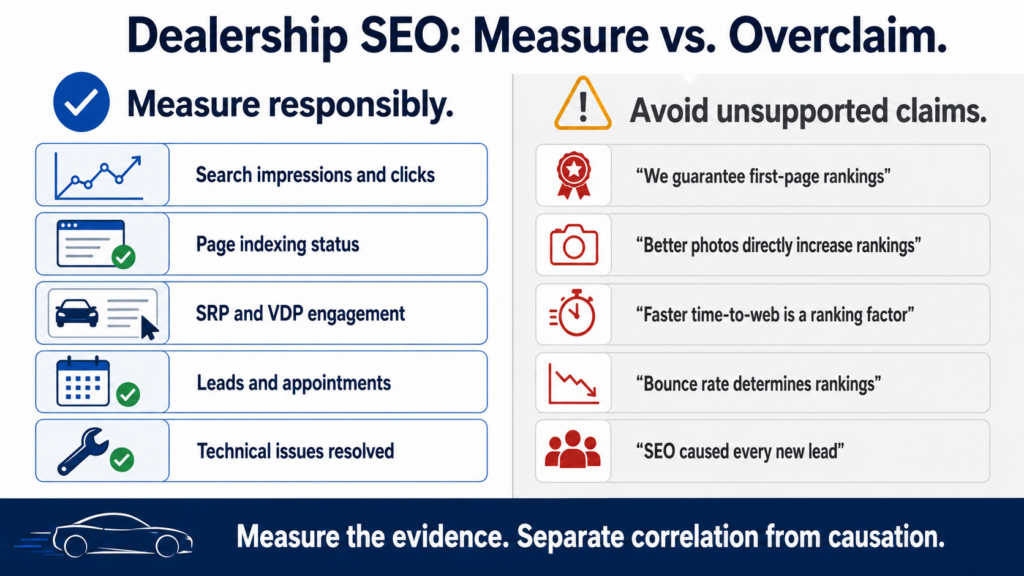
Measure what search platforms and dealership systems actually show, and separate useful operational improvements from unproven ranking claims.
Search Console can be used to monitor impressions, clicks, indexing status, and search queries. Pair this with website analytics to understand on-site behavior. Remember that these platforms show activity, status, and correlation—not proof of causation—as clarified in Google’s Search Console documentation.
Dealerships can also monitor business-context indicators such as:
- SRP and VDP engagement.
- Inventory-page interactions.
- Calls and form submissions.
- CRM leads and appointments.
- Store-level differences across rooftops.
These indicators help marketing leaders understand the commercial context around organic search. Correlation between SEO activity and dealership outcomes does not, by itself, prove that SEO caused the change.
Measure versus overclaim
| Reasonable operational recommendation | What not to claim |
|---|---|
| Keep inventory accurate and pages complete | Photo completeness or inventory freshness directly increases rankings |
| Publish vehicle media quickly and consistently | Time-to-web is a ranking factor |
| Use useful, accessible images with alt text | Image quality, AI backgrounds, or 360 media directly improve rankings |
| Improve Core Web Vitals and page usability | Core Web Vitals are the primary ranking factor |
| Use canonicals to consolidate duplicate signals | Canonicals guarantee that Google selects a specific URL |
| Track engagement to understand shopper behavior | Dwell time or bounce rate are confirmed Google ranking factors |
Governance across a dealership group
Governance keeps all six layers functioning over time.
A practical cadence could include:
- Monthly: Review indexing, search performance, VDP completeness, inventory workflows, and open technical issues.
- Quarterly: Review content coverage, local profile accuracy, agency performance, tool usage, and ownership.
- Continuously: Maintain a named owner and escalation path for each layer.
For a dealership group, decide what should be centralized and what should remain with each rooftop.
Central responsibilities may include:
- Templates and brand standards.
- Measurement definitions.
- Website governance.
- Provider contracts.
- Business Profile policies.
- Media and merchandising standards.
Store responsibilities may include:
- Accurate location information.
- Local review responses.
- Store-specific content and events.
- Local workflow execution.
A phased rollout sequence
Before beginning, verify that the following prerequisites are in place:
- A crawlable, mobile-parity website.
- A reliable inventory feed to the website.
- Access to Search Console and analytics.
- A named accountable owner.
The accountable owner should approve this readiness checklist before work begins.
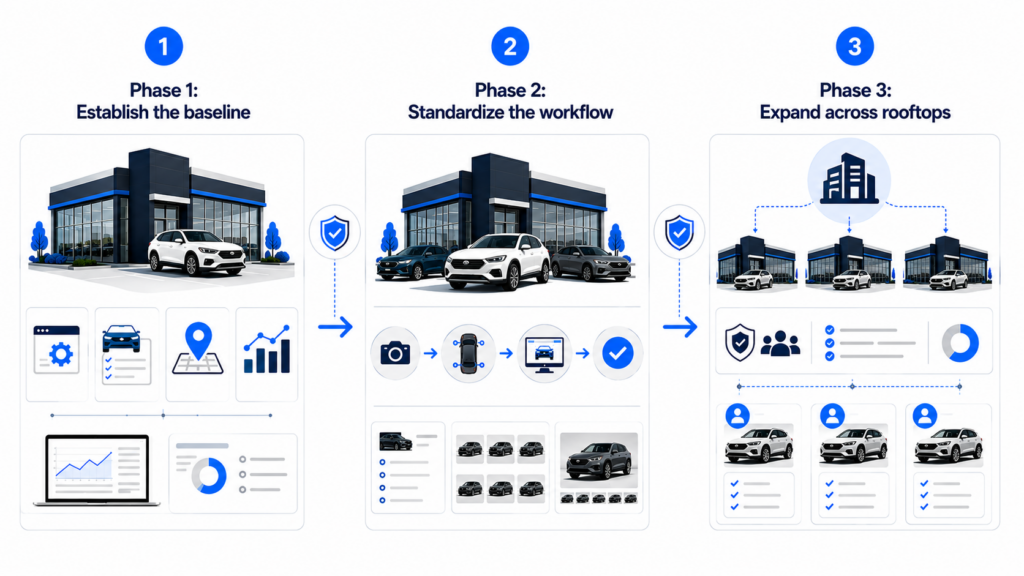
Phase 1: Establish the single-rooftop baseline
- Check indexing and resolve significant crawl or technical blockers.
- Confirm that SRP and VDP URLs are crawlable.
- Review inventory accuracy and VDP completeness.
- Claim and review the primary Business Profiles.
- Establish baseline Search Console and analytics reporting.
Phase 2: Deepen the single-rooftop program
Build content around the buyer journey, standardize the VDP media and merchandising workflow, and establish the measurement cadence.
The marketing manager should be accountable. Proceed only when the content process, media workflow, and measurement cadence are functioning consistently at the initial rooftop.
Phase 3: Expand across the dealership group
Roll approved templates, standards, and responsibilities out to other rooftops. Define which responsibilities belong centrally and which belong to store teams.
The CMO should be accountable, with the marketing manager responsible for execution. Expand only when each new rooftop can meet the group’s documented standards for ownership, content, local execution, and media workflows.
Build a more consistent vehicle-media workflow
SEO may help shoppers discover inventory, but the VDP still needs complete and consistent content when they arrive.
CarCutter for dealerships supports the operational workflow behind vehicle imagery, from guided image capture to standardized processing and distribution across dealership systems. Teams can also add interactive vehicle presentation through CarCutter’s Next Gen 360°.
CarCutter does not replace your SEO team, website platform, or local-search tools. It strengthens the media and merchandising process that supplies your vehicle listings.
Ready to review how vehicle capture, quality assurance, and publishing work across your dealership? Book a CarCutter demo!
FAQ
The technical and content fundamentals are the same, but dealerships manage rapidly changing inventory, multiple departments, physical locations, and a vehicle-media pipeline. These operational requirements make clear ownership and governance especially important.
Supported structured-data types can communicate eligible information about a page or business when the implementation fits. They do not guarantee rich results. Vehicle Listing structured data is no longer supported as an organic Search feature, according to Google’s June 2025 announcement.
There is no reliable universal timeline. The starting point, market, website condition, available resources, and competitive environment differ between dealerships. Focus first on the operational health of each layer and monitor performance over time.
Professional imagery is not a documented direct ranking factor. Crawlable images, descriptive alt text, and relevant surrounding text can help search engines understand image content and support accessibility.