


Dealer Inventory Photo Process:
How to Get Cars Online Faster and Increase Inventory Turn.
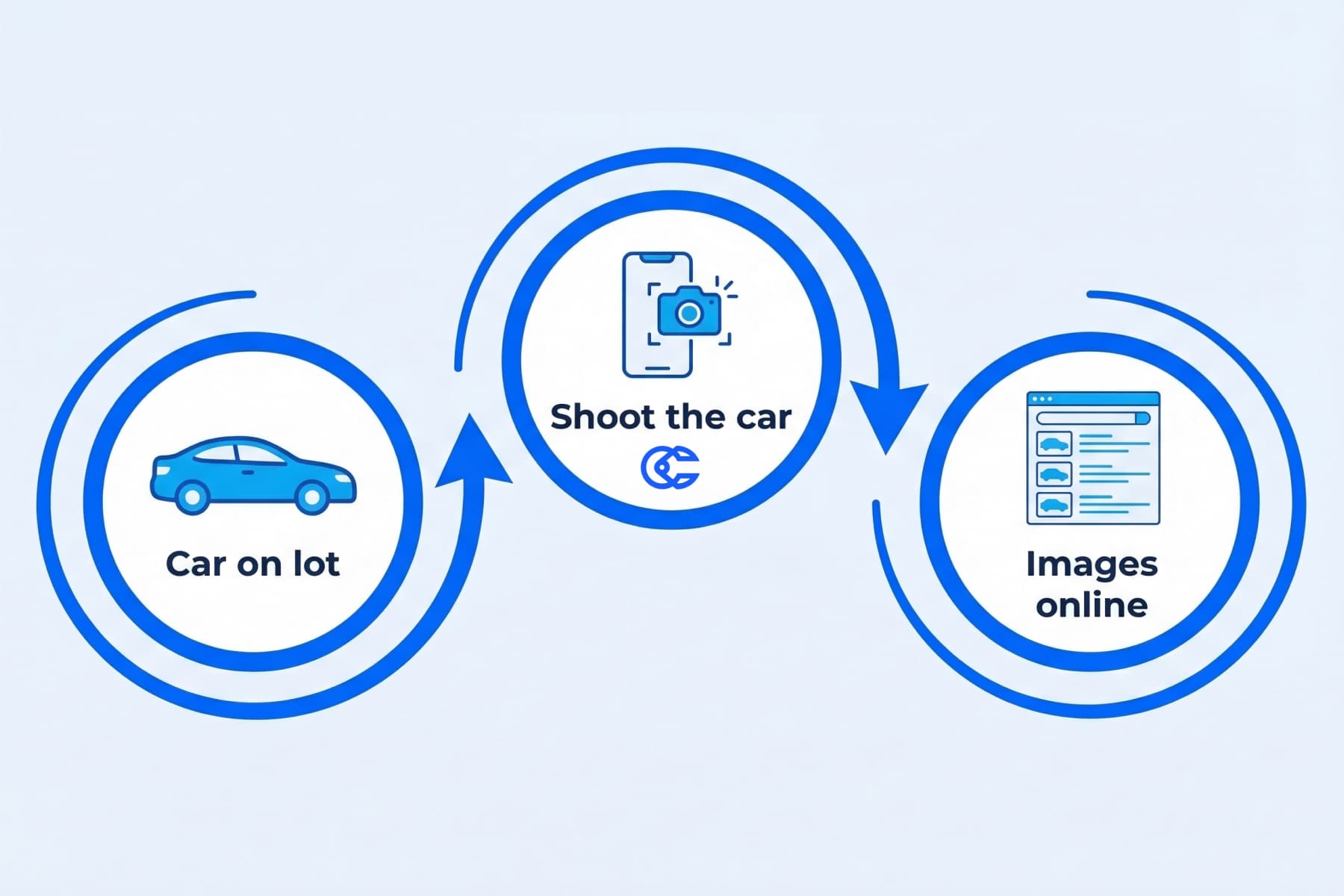
Every unphotographed car on your lot is a silent budget leak. It racks up floor plan interest, generates zero leads, and ages while shoppers scroll past your competitors’ listings. A solid dealer inventory photo process is the operational fix that shrinks days to list, protects gross, and turns your inventory into a lead engine. This guide walks you through the exact workflow to make it happen.
TL;DR:
Most dealerships lose 7 to 9 days between acquisition and a live listing because their photo process has no structure. A repeatable dealer inventory photo process needs:
- A fixed trigger in recon,
- clear ownership,
- a standard shot list,
- automated publishing,
Such a process can cuts days to list from over a week to under 24 hours.
The result: lower holding costs, more VDP engagement, and faster turns.
Why Invisible Inventory Is Costing Your Dealership Every Day
You just bought 12 cars at auction. Recon is backed up. Your lot porter is covering for someone on PTO. And somewhere in the chaos, 40 cars sit on the lot without a single photo online.
No photo means no VDP. No VDP means no shopper engagement. No engagement means no lead. This is not a photography problem. It is a process problem, and it hits the P&L directly.
Eevery unphotographed car is ageing the floor plan. Cox Automotive illustrates how holding costs can run $44.63 per unit per day once you factor in floor plan interest, insurance, and depreciation. Multiply that across 40 unfotoed units and 7 lost days, and you are looking at over $12,000 in carrying cost before a single shopper has seen those cars.
The math is straightforward: every day without photos is a day without leads and a day with costs.
How to Build a Repeatable Dealer Inventory Photo Process
A dealership vehicle photography workflow does not need to be complicated. It needs to be consistent and tied to your recon pipeline. Here is a 5-step framework that works across rooftops of every size.
Step 1: Trigger the photo at a fixed point in recon.
Do not wait until a car is “front-line ready” to start shooting. Assign photo capture to a specific stage in your recon workflow, for example, the moment a car clears safety inspection. This shrinks the gap between recon completion and listing.
Step 2: Assign clear ownership.
Decide who shoots. Whether it is a lot porter, a dedicated photographer, or a rotating team member, the role must be defined with a daily shot list. Unclear ownership is the number 1 reason cars sit unfotoe
CarCutter’s mobile app offers guided capture with shot list templates that tell the photographer exactly which angles to capture and in what order. This removes guesswork for anyone holding the phone, even if they have never shot a car before. The app also includes VIN scanning and real-time AI quality checks, so issues are flagged before the car moves off the photo station.
Step 3: Standardize the shot list.
Every car should get the same set of angles: front 3/4, rear 3/4, driver profile, interior wide, dash, odometer, and any condition-specific shots. Standardization is what makes your SRPs look uniform and your team fast.
Step 4: Automate the handoff.
Once images are captured, they should not sit on someone’s phone waiting to be emailed or uploaded manually. CarCutter’s automatic IMS/DMS sync pushes processed images directly to your inventory system the moment they clear QA. No manual upload. No waiting on a third party.
Step 5: Set a daily publishing cadence.
Photo capture should be a daily task, not a weekly batch job. The stores that list within 24 to 48 hours of recon completion are the ones winning the VDP traffic game.
If you want to build this process faster, CarCutter’s shot lists and Hub dashboard help dealerships standardize their workflow across locations.
What to Track to Keep Your Photo Workflow Accountable
Process without measurement is just hope. Here are 4 metrics every GM should track to keep the car dealer photo inventory management pipeline accountable.
1. Days to photo.
Measure the gap between vehicle acquisition (or recon completion) and photo upload. If this number is above 2 days, you have a bottleneck that is costing you leads.
2. Percent of inventory photographed.
At any given time, what share of your retail-ready inventory has real photos online? Dealer.com data shows that on sites where over 65% of inventory features real photos, customers view 20% more VDPs.
3. Time to web.
This is the full cycle: from the moment a car enters inventory to the moment it is live on your website with photos, pricing, and a complete listing. CarCutter Hub‘s time-to-web analytics let you monitor this metric by rooftop, by team member, and by day.
4. VDP engagement per vehicle.
Track how shoppers interact with your listings. According to vAuto, 67% of VDP visits engage with the media carousel. If your photos are inconsistent or missing, you are losing that engagement. Dealer.com research confirms that 90% of car shoppers say photos are an important aspect of their shopping journey.
What Happens When the Process Works
When a dealership group of roughly 25 rooftops in Germany implemented CarCutter’s mobile app and standardized their photo workflow, they reduced capturing time significantly. Across hundreds of units per month, that translates directly into faster listings, lower holding costs, and more shopper engagement during the critical first days on market.
A working dealer inventory photo process produces a predictable chain of outcomes:
- Cars go online within 24 hours of recon, not 7 to 9 days
- VDPs are populated with consistent, high-quality real photos that drive engagement
- Floor plan holding costs shrink because vehicles are visible to buyers sooner
- Your team stops firefighting and starts operating with a repeatable daily rhythm
CarCutter’s AI background processing ensures every image looks showroom-grade, whether the car was shot on a busy service drive or a gravel lot. Combined with the Hub’s QA workflows and multi-location team controls, the entire pipeline from capture to publish runs without manual bottlenecks.
Start With One Change, Then Scale
You do not need to overhaul your entire operation overnight. Pick the biggest gap in your current dealer inventory photo process and fix that first.
- If cars are sitting unfotoed for days, assign a daily owner and a trigger point in recon.
- If photos look inconsistent across your lot, standardize with a shot list template.
- If the handoff from capture to listing is manual and slow, automate the publish step with an IMS/DMS integration.
Each fix is additive. Layer them together, and you have a process that turns inventory into leads on a predictable schedule instead of whenever someone remembers to grab the camera.
If you want a faster path to a standardized, scalable photo workflow, CarCutter’s Hub and mobile app work together to take the guesswork out of inventory imaging. See how it works with one of our experts.
FAQ
A dealer inventory photo process is a structured workflow that defines who photographs each vehicle, when in the recon pipeline photos are taken, what angles are required, and how images are delivered to your website or listing platforms. Its purpose is to minimize the time between vehicle acquisition and a live, photo-complete online listing.
Best-performing dealerships aim to have vehicles listed with real photos within 24 to 48 hours of completing reconditioning. Many stores average 7 to 9 days or longer, which increases floor plan holding costs and delays lead generation.
Every day a vehicle sits on the lot without an online listing, it accrues holding costs from floor plan interest, depreciation, insurance, and storage. Cox Automotive estimates holding costs can reach $44.63 per unit per day. Hence, it stands to reason that cars without pictures generate zero online leads while accumulating costs.
A standard shot list typically includes front 3/4, rear 3/4, driver-side profile, passenger-side profile, interior wide angle, dashboard, odometer, and any condition-specific detail shots. Consistency across every vehicle makes SRPs look professional and keeps the team efficient.
According to Dealer.com, used and certified vehicle listings with real photos are 40% more likely to generate a lead than listings with stock photos. Dealerslink, citing Kelley Blue Book data, found that upgrading from stock images to high-quality real photos can increase VDP traffic by up to 675%.
CarCutter’s mobile app provides guided capture with shot list templates, VIN scanning, and real-time AI quality checks. Once captured, images are automatically processed with AI backgrounding and synced directly to the dealership’s IMS or DMS. CarCutter Hub provides centralized QA workflows and time-to-web analytics to monitor the entire pipeline.