



AI Car Photography for Dealerships: What Dealers Really Think
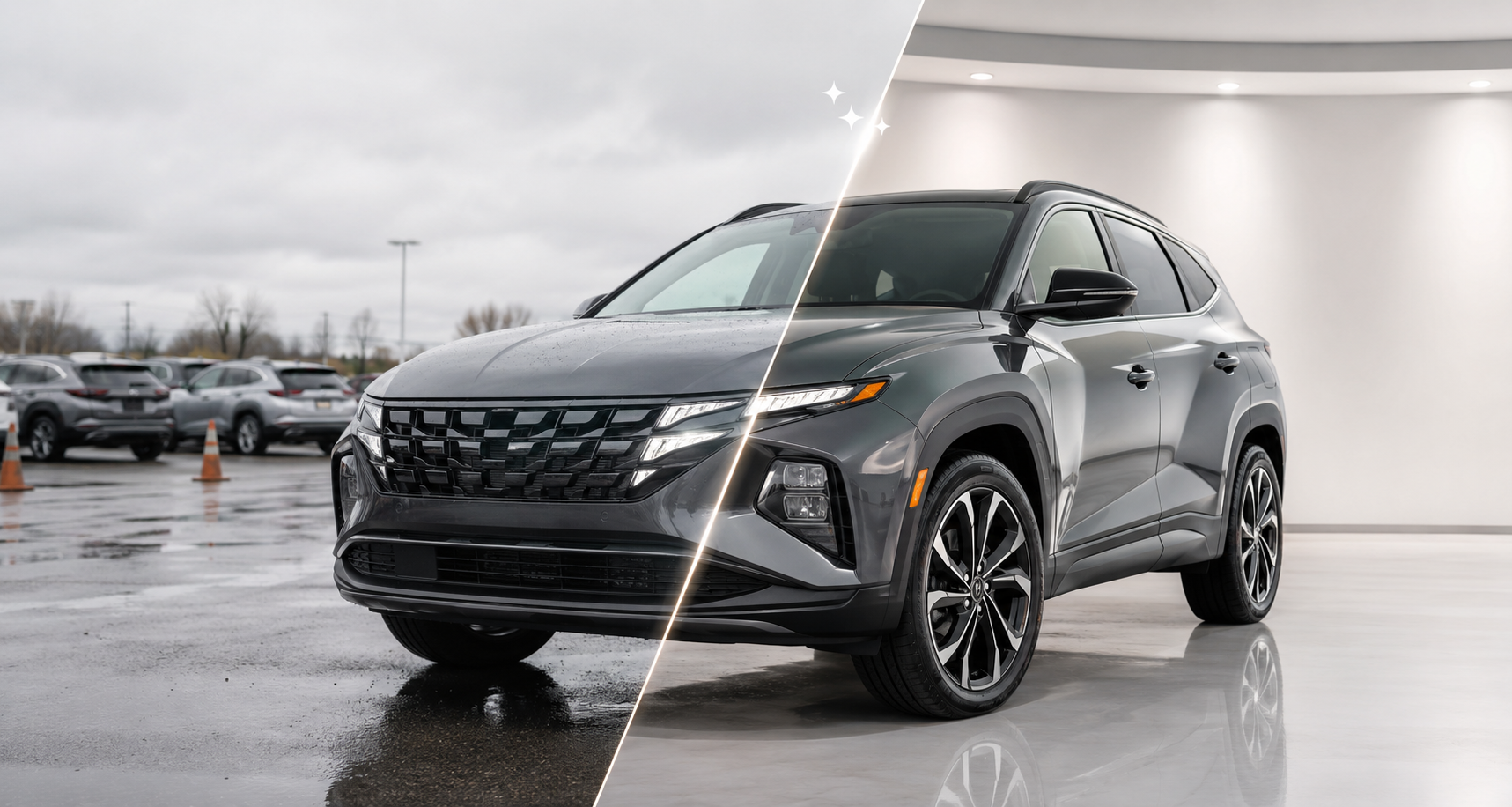
AI car photography for dealerships delivers its clearest benefits in two places: the time it saves and the quality of the images buyers see online. That is the story emerging from the CarCutter Experience Survey, 2026, in which dealerships across eight countries rated their experience with the platform, and in which every single respondent pointed to AI photo editing and backgrounding as one of the capabilities that mattered most.
Key findings from the CarCutter Experience Survey, 2026
- 78% said they were very satisfied (rating CarCutter 4 or 5 out of 5).
- 100% of respondents found that CarCutter’s AI photo editing and backgrounding was highly impactful.
- The three most valuable aspects of CarCutter, according to respondents:
1) photo and visual quality,
2) time savings on the photo process,
3) 3D virtual car showrooms.- Time-to-market was the number one benefit dealers described in their own words.
- Location independence, with no dedicated photo booth or scenic backdrop required, stood out as a practical, everyday win.
Who took part
Respondents spanned eight countries, led by the United States and joined by Finland, Austria, the UK, Spain, Luxembourg, France, and Italy. They ranged from single-user operations to dealership groups running CarCutter across large multiple rooftops operations, and from brand-new adopters to teams with more than two years on the platform. In other words, the feedback reflects a genuine cross-section of dealership sizes, markets, and experience levels.
Does AI car photography save dealerships time?
Yes, and time was the benefit dealers raised more than any other. When asked to describe the single biggest change in their own words, speed and time-saving came out on top as the number one theme, well ahead of everything else.
The verbatim comments say it best. Carcart LTD in the UK summed up the change as a “faster process.” Alzaga Motor SA in Spain credited “speed and quality.” YP Auto in France called the workflow “fast, clean and easy to use.” The reason is simple: automated car photography closes the gap between capturing a vehicle and publishing a finished, edited image, so cars reach shoppers sooner.
You can see this play out at scale. One of California’s largest dealer groups turned CarCutter into a high-volume photo engine:
DGDG Scales its Photo Operations Thanks to CarCutter
DGDG has used CarCutter to scale their photo ops to more than 1,200 photos per month across their 17 dealerships in the USA.
Do dealerships still need a photo booth?
For many respondents, the answer is no, and this was one of the more strategically interesting findings. Location independence, the ability to produce showroom-grade images without a dedicated photo bay or a drive to a scenic backdrop, stood out as a clear practical benefit.
Gilbert Ford & Gilbert Chevrolet in the US put it plainly: “Less need to drive vehicles to good photo spots with background removal.” Kyttälän Autot Oy in Finland reported “no need to find a photo location.” ITC Leasing in Austria went further, describing how dealership AI vehicle photography let them showcase stock they did not even hold on-site: “By recreating the showroom, cars not on-site can now be showcased better, no post-processing required.” For any dealer weighing the cost of building or maintaining a photo studio, that shift is worth putting a number on.
Is it easy for non-technical staff?
Ease of use was one of the most common themes, and it matters, because vehicle photography is often handled by rotating lot staff rather than trained photographers.
CMA Volvo Cars of Charlottesville in the US kept it to three words: “Just made it simple.” Azzurra Holding in Italy described the operational impact in more detail: “We standardized the process, speeding it up and making it easy for all operators, even less technical ones.” When a workflow is accessible to non-specialists, photo output no longer hinges on any single person being available.
Which features drove the most value?
Respondents were clear about where CarCutter earned its keep. The three most valuable aspects they identified were, in order:
- Photo and visual quality
- Time savings on the photo process
- 3D virtual car showrooms
The specific features dealers singled out as highest impact:
- AI photo editing and background removal, named by 100% of respondents
- Virtual showrooms, named by half of respondents
- Guided capture and shot guidelines
- NextGen 360 spins
- DMS and IMS integrations
And the benefit areas they valued most:
- Photo and visual quality
- Saving time on image editing
- Improving the online buying experience
- Team efficiency and workflow
- Getting vehicles to market faster
The pattern is consistent: the capabilities dealers valued most map directly onto the outcomes they care about, cleaner images produced faster, and a stronger online buying experience.
Can it standardize photos across multiple rooftops?
For marketing leaders overseeing several stores, consistency is often the real prize, and the survey speaks to it directly. Even across eight countries with different lots, lighting, and staff, uniformity came up again and again in the open comments.
Stanley Subaru in the US described the effect on their vehicle detail pages: “Our VDP photos now look more professional and uniform.” Chrome Digital 360 noted that the “alignment of photos improved.” For a group CMO, consistent backgrounds and framing across every rooftop’s VDPs mean the brand looks like one brand online, no matter which store captured the car, a benefit that only compounds as the group grows. Europe’s Autosphere by Emil Frey saw exactly that, using CarCutter to keep vehicle image quality consistent across 18 locations while meeting their group’s demanding quality charter (watch the Autosphere by Emil Frey client success story).
Larger groups see the same effect on brand consistency. Ourisman Auto Group standardized vehicle imagery across every rooftop and brand:
Ourisman Delivers One Consistent Brand at Scale
Ourisman Auto Group captures 5–10 cars per hour with consistent, photo-booth-quality images across 18 locations and 16 brands.
How this fits the wider market
These findings come from 14 CarCutter customers across eight countries. It is a focused, directional snapshot rather than a large-scale market study, but the direction it points lines up neatly with broader industry research on AI in automotive retail. The 2025 Cox Automotive Car Buyer Journey Study, published in January 2026 found that 63% of US dealers say investing in AI now is critical to long-term success, and that 84% of “mostly digital” buyers who used AI-powered tools reported high satisfaction. Separately, CDK Global research published in July 2023 found that 76% of auto dealers credit AI with positively impacting sales, inventory, service, and parts. CarCutter’s own customers are simply living that shift day to day.
What this means for your dealership
For a GM or Dealer Principal: the wins are operational. Faster turnaround from lot to listing, far less dependence on a dedicated photo booth, and a workflow simple enough for non-technical staff. If your bottleneck is the time between acquiring a vehicle and merchandising it online, that is exactly where dealers reported the clearest gains.
For a group CMO or Marketing Manager: the value concentrates in consistency. Uniform, professional VDP imagery across every rooftop protects brand presentation at scale and strengthens the online buying experience that so many respondents said improved.
To understand the capabilities behind these outcomes, take a look at our overview of AI in car photography, then book a short walkthrough with your own vehicles in hand.
Ready to see it on your own inventory?
The dealers in this survey did not just rate CarCutter highly, they changed how their teams work every day: shooting on the lot instead of in a photo booth, publishing cars in hours instead of days, and presenting one consistent, professional brand across every rooftop. The best way to know whether AI car photography can do the same for your dealership is to see it working on your own vehicles. Book a free CarCutter demo and we will walk you through guided capture, AI backgrounding, and virtual showrooms with your inventory in hand, so you can picture the results before you commit.